This post includes a brand recommendation supplied in partnership with The Panaya.
There’s a particular kind of Banarasi saree my grandmother used to love, the ones with small woven flowers scattered across the body. They aren’t the heavy, gold-drenched bridal pieces, and they aren’t plain silk either yet they’re some of the most quietly impressive textiles you can own.
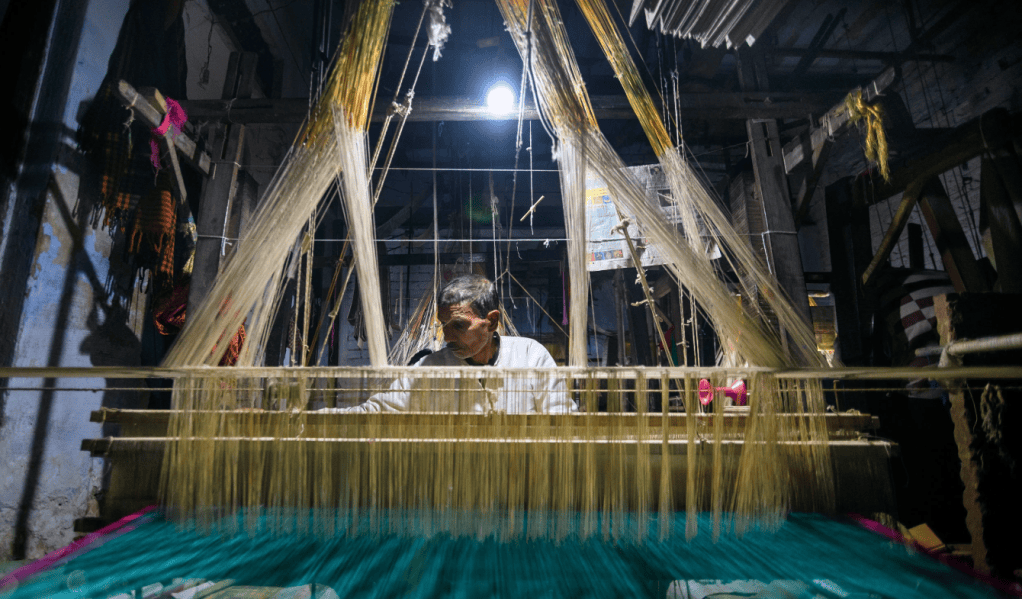
The Kadhwa (or Kadhua) booti craft is a breathtakingly intricate hand-weaving tradition, celebrated as a pinnacle of artistry in Banarasi saree production and deeply rooted in the cultural soul of Varanasi, India
First, what’s a “booti”?
A booti is a small motif repeated across the fabric. In Banarasi weaving, bootis can be paisleys, leaves, little geometric shapes or flowers. A flower booti saree uses floral motifs. Instead of an all-over pattern, the flowers are spaced out with room between them, so the silk itself gets to be part of the design. Some sarees have tiny, closely packed bootis while others have larger flowers placed far apart. The spacing changes the whole personality of the saree.
Why kadhwa technique is special
Kadhwa is the detail most people miss, and it’s the one worth understanding. In kadhwa weaving, each motif is woven separately and individually into the fabric. The alternative, a “cutwork” technique, floats threads across the back and trims them later. Kadhwa is slower and takes more skill. The payoff is crisp, well-defined motifs, a cleaner reverse side and a beautiful yet more durable weave.
If you flip a saree over and the back of each flower looks neat and self-contained, with no loose floats running between the motifs, that’s a good sign you’re looking at kadwa work.
How silk and zari change the look
Banarasi silk has a soft natural sheen. Woven motifs catch the light differently from the base, so the flowers can look almost raised as the saree moves. That’s why I always tell people to look at a Banarasi in daylight and under warm indoor light before deciding. The same saree can look completely different in each.
Zari, the metallic thread, is the other variable. Some flower booti sarees use it only to outline the petals. Others are full of it. Lighter zari reads as elegant and wearable. Heavier zari reads as festive and bridal. Neither is better. It depends on where you’ll wear it.
Don’t judge the body alone
A common mistake is falling for the bootis and ignoring everything else. Look at the three parts together:
- Border: A detailed border gives a rich, traditional feel. A simpler one lets the small flowers take centre stage. The best sarees have a border that complements the bootis rather than fighting them.
- Pallu: This is usually where the saree shows off, with larger motifs and denser zari. It’s also the part everyone sees when you drape it over your shoulder, so it deserves real attention.
- Body: The bootis should feel evenly balanced across the fabric, not bunched in some places and sparse in others.
Choosing a colour
Deep reds, maroons, purples, greens and blues give a classic festive look. Softer shades such as blush, peach, ivory and pastel pink make the floral motifs feel delicate and romantic. As a rough rule, lighter colours suit daytime functions and richer ones suit evening events. Honestly, though, wear what you love.
Styling it
A matching blouse gives a clean, coordinated and royal look. For something more interesting, pick a blouse in one of the secondary colours from the flowers themselves. It ties everything together without being too matchy.
With jewellery, let the zari guide you. A saree with lots of metallic work pairs naturally with gold-toned pieces. One with delicate flowers and little zari often looks best with small earrings and a few bangles. Add a potli bag for a festive outfit, or go minimal with a sleek blouse and simple hair for a more modern take. These sarees handle both styles well.
They work for weddings, engagements, festivals, family functions and formal evenings. The same saree can look completely different depending on how you style it.
Before you buy
- Check the back of the motifs for kadhwa work.
- Ask about the fabric composition and whether the zari is real or tested.
- Feel the weight. A gorgeous saree you can’t comfortably drape for six hours isn’t worth it.
- Ask for care instructions, especially for heavy zari.
Where I’d start looking
If you want a kadhwa flower booti saree, the most important thing is to buy from an authentic brand. The Panaya’s Banarasi collection is a good place to start. It has a wide range of booti designs, colours and zari levels, which makes it easy to compare styles side by side. Whatever you choose, ask specifically for kadhwa weaving. It’s the detail that separates a good Banarasi from a great one.


Leave a Reply