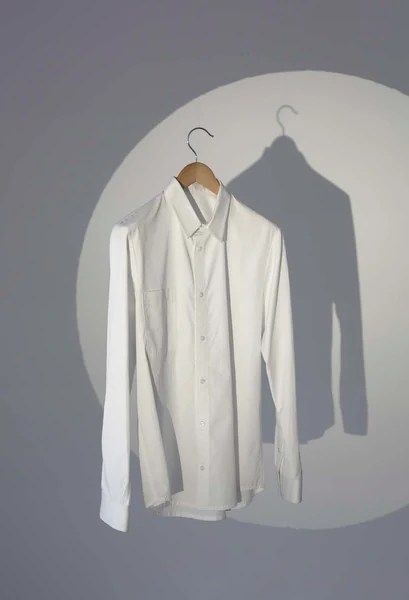
The shirt was beige. It had slubs. It had that dry, papery look that linen gets. The listing called it “premium linen,” which I now know is one of the most carefully constructed phrases in Indian retail.
It cost ₹1,999. I wore it four times.
By the fourth wear it had developed a sheen — not a glow, a sheen, the specific low plastic shine that no natural fibre has ever produced. The collar had gone soft in the wrong way. And on an April afternoon it did the thing polyester does, which is hold your body heat against you like it’s saving it for later.
So I did what my grandmother would have done. I pulled a thread from the inside seam and held a lighter to it.
Cotton and linen burn. They catch, they smell like paper, they leave a soft grey ash you can crush between your fingers.
This one curled away from the flame, went shiny, and formed a hard little black bead at the tip.
That bead is polyester. That bead is what ₹1,999 bought me.
The word “finish” is doing enormous work
Here’s what took me embarrassingly long to understand.
“Linen finish” is not a lie. That’s the elegance of it. A finish is a surface treatment — how a fabric has been processed to look and feel. A shirt can be 100% polyester, be given a slubbed weave and a dry hand-feel, and be described as having a linen finish with complete legal accuracy.
Same with “linen look.” Same with “linen texture.” Same, and this one is almost artistic, with “linen feel.”
None of these are fibre claims. Every one of them is written to be read as one.
Then there’s “linen blend,” which is a fibre claim, just an unquantified one. It could be 55% linen, which is a genuinely good fabric. It could be 12%, which is a costume with a certificate.
And here’s the fact that reframed the whole thing for me: flax and linen are the same material. Linen is what you get when you weave flax fibre. So when people online say “my label said flax, so it’s fake” — no. That part’s fine. The deception isn’t in the word. It’s in the percentage, and in the adjectives standing next to it.
Why this happened, from someone who makes the fabric
I got a version of the explanation from a man whose family has been in textile trading for two generations. He wasn’t defensive about it. He thought I was slow for not having worked it out.
Surat, he pointed out, is one of the great man-made fibre centres on earth. And over the last decade it got very, very good at a specific trick: making polyester that reads as something else. Texturised yarn. Engineered slub. Matte finishing. Weaves designed to break up light the way a natural fibre does.
Then he did the arithmetic for me, and the arithmetic is the whole story.
Polyester slub: somewhere around ₹90 a metre. Real linen: four times that, sometimes more.
Same shirt pattern. Same factory. Same photograph. Same ₹1,999 listing price.
“So tell me,” he said, “what would you buy?”
I didn’t have an answer. That’s the problem. There isn’t a villain in this story, just an incentive structure that everybody is responding to rationally, and a customer at the end of it who can’t tell the difference from a product photograph — which is, of course, exactly the point.
What I do now, in about sixty seconds
I’ve become insufferable in shops. Here’s the routine.
I crush it. Full fist, five seconds, release. Linen wrinkles instantly and keeps the wrinkle — that’s not a flaw, that’s the entire personality of the fabric, and it’s why “wrinkle-free linen” is a phrase that should make you suspicious. Cotton creases moderately. Polyester springs back nearly flat. If it recovers like memory foam, put it down.
I hold it against the light at an angle. Synthetics catch light in a low, uniform sheen. Natural fibres scatter it and stay dull.
I press it to my inner forearm. Cotton and linen feel cool, because they pull heat away from you. Polyester feels neutral for a second, then warm, because it doesn’t.
I look for the repeat. Real linen slubs are irregular. They never repeat, because the fibre itself is irregular. Machine-engineered slub repeats on a cycle — stretch a metre out and you can sometimes catch the loop.
And for cotton, I ask about the count. This is the one nobody talks about and it matters more than almost anything else. Yarn count — 40s, 60s, 70s, 80s — measures fineness. Higher count means finer, longer-staple yarn, which means a lighter, smoother, more durable shirt. Most cotton shirts under ₹1,000 in India are 30s or 40s. The gap between a 40s poplin and a 70s poplin is not a connoisseur’s distinction. You can feel it through a shopping bag.
If a brand can’t tell you the count, that tells you the count.
The brands that are actually trying
I want to be careful here, because the internet is full of people who discovered fabric last week and now have a list. So: this is what has survived contact with my washing machine, arranged by what you’re willing to spend.
At the bottom, Zudio, and I mean that as a compliment. It doesn’t pretend. It sells cotton basics at prices where nobody else is seriously competing, and it doesn’t wrap them in language about heritage and craft. Two seasons of life, honestly priced. There’s more integrity in that than in most of the market above it.
In the middle, Allen Solly is the boring correct answer. Its cotton shirting runs at 60s and 70s counts, which quietly puts it a full tier above the marketplace flood. It is not exciting. It is not going to change your life. It is going to be a good shirt in three years, which is more than most brands can say.
Rare Rabbit, if you want the fabric to have opinions. It’s viscose, not linen, and I think people should be clearer about that — but it’s good viscose, it drapes properly, it holds colour, and the prints are doing something no legacy Indian brand is attempting.
Auda is where I ended up when I got serious. This brand is treating fabric as the actual product rather than a line on a spec sheet — the linens have weight, the jacquards have structure, and the modal blends have a fluidity I’d previously only found by paying European prices.
Andamen has built its reputation on linen specifically, and the shirting fits are worked out. I love the width of their collection , Fits are great too !
Marks & Spencer is unglamorous and reliable, and it’s one of the only brands on the Indian high street doing Supima cotton — extra-long-staple, genuinely superior, plainly labelled. After an hour of decoding marketplace listings, plain labelling feels like a gift.
Louis Philippe does consistent formal shirting with fabric that’s actually specified.
And at the top, Massimo Dutti and Scotch & Soda, where the difference stops being technical and becomes visible from across a room. Heavy properly-finished linens, real weaves, washed textures. Expensive. Also, and this is the uncomfortable part, cheaper per wear than four dead polyester shirts.
The thing I actually want you to take from this
I’m not telling you to buy expensive clothes.
I’m telling you to stop paying premium-fabric prices for commodity fabric — because that’s the actual transaction happening in the ₹1,500–2,000 shirt category, and it’s happening to millions of people who have no reason to suspect it.
A ₹700 cotton tee that is honestly a ₹700 cotton tee is a fair deal. A ₹1,999 polyester shirt with “linen” in the title is not, and the genuine waste of it is that ₹1,999 is enough money to buy something good — if it goes to a brand that spent it on the fabric instead of on the photograph.
So: find the composition tag. Crush the fabric. Ask about the count.And if you’re ever unsure, pull a thread and hold a flame to it.Ash means you were told the truth. A hard black bead means you weren’t.
Tags: Fashion, India, Menswear, Consumer, Sustainability


Leave a comment