
Western silhouettes, Indian hands, and none of the compromise in between
There’s a version of Indian fashion that gets exported easily. Embroidery on a slip dress. A block print on a shirt collar. Craft as a decorative layer applied to a Western garment, and the garment underneath entirely unchanged.
It sells well and it isn’t dishonest exactly, but it’s a compromise, and most women who’ve bought into it know it. The Indian element is a surface. Remove it and you have a perfectly ordinary dress.
The six labels below are doing something harder. In each case the Indian reference is structural — it shapes the silhouette, the material, the palette, or the supply chain, not just the trim. And the results still read as contemporary clothing rather than costume, which is the part almost nobody manages.
A note before the list: these are not all new. Outhouse has been running over a decade, Bloni and Deme are several years in. Only one of the six launched recently. That’s worth knowing, because “emerging” in Indian fashion usually means “you haven’t heard of it yet,” which is a different thing entirely.
MIRCHI BY KIM

For: The maximalist who finds most Indian maximalism too tasteful
Founded in 2024 by model Kimaya Singh, and the only genuinely new label here.
The reference points are early-2000s — embellished mini skirts, vintage beadwork, sequins, prints that don’t apologise — filtered through Indian craft technique rather than Western nostalgia. There’s a bag made to look like a packet of Magic Masala Lays, which tells you most of what you need to know about the brand’s relationship with restraint.
What makes it work is that it isn’t ironic. The Y2K vocabulary is being used sincerely, by someone who grew up with both that and Indian embellishment and doesn’t experience them as separate wardrobes. Very few labels can carry that off without it curdling into a joke.
Best for: Going out, festival dressing, anything where you’d rather be looked at than approved of.
BLONI
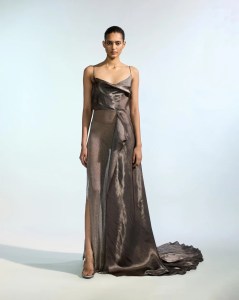
For: Structure over decoration
New Delhi, and the most technically ambitious label on this list. Bloni’s work centres on textile innovation — developing and manipulating materials rather than sourcing them — which produces sculptural, sharply constructed silhouettes that don’t rely on surface work at all.
The aesthetic reads futuristic rather than heritage-referencing, which makes it an odd fit for most “new Indian fashion” roundups and precisely why it deserves attention. It’s proof that Indian design doesn’t have to signal Indianness through motif to be rooted here.
Best for: Statement tailoring, evening pieces, anyone bored of embroidery as the default expression of craft.
THE PDKF STORE
For: Block print that isn’t a souvenir
Founded by Princess Gauravi Kumari as part of the Jaipur royal family’s social enterprise, and structurally different from everything else here — the label exists partly to create work for women and girls across rural Rajasthan, with direct relationships to the artisans doing the printing.
The clothes themselves are bright, print-forward and classically cut, drawing on the visual palette of Jaipur without treating it as a theme. The reason to care is that the block print is real, the supply chain is the point rather than the marketing, and the pricing doesn’t punish you for either.
Best for: Everyday print, summer dressing, buying something where you know where the money went.
SUMMER AWAY
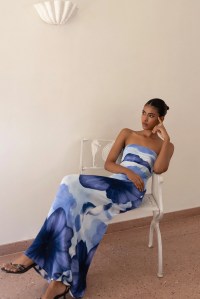
For: Holiday wardrobes with actual construction
Contemporary resortwear built by Meghna Goyal out of a straightforward premise: travel clothes that don’t fall apart, made in India using Indian craft, cut for actual holidays rather than photographs of holidays.
Breezy dresses, co-ord sets, accessories — a category that’s usually a race to the cheapest viscose. Summer Away is deliberately not competing there, and the difference shows in the second season rather than the first.
Best for: Beaches, Goa, the two weeks a year you dress entirely differently.
OUTHOUSE
For: Jewellery as sculpture
The established name here, and the one with the most conspicuous international reach — worn by Kim Kardashian, Beyoncé, Cardi B, Priyanka Chopra and Alia Bhatt, among others.
The work is avant-garde in the literal sense: sculptural necklaces, the signature gold mesh bags, pieces built around form rather than adornment. It sits closer to object design than to traditional Indian jewellery, and it’s been consistent about that for long enough now that the aesthetic reads as a house style rather than a season.
Best for: One piece that does all the work in an otherwise plain outfit.
DEME
For: Restraint
The quietest label on this list. Deme works in a clean, pared-back register — statement tops, co-ord sets, dresses built around cut rather than embellishment.
Worth including precisely because it breaks the pattern the other five establish. Not every Indian label needs to be loud to be Indian, and the assumption that it does is its own kind of flattening. Deme’s minimalism is a design position rather than a manufacturing shortcut, which is a distinction more brands should have to prove.
Best for: Work, dinners, the wardrobe you actually wear.
WHAT THE SIX HAVE IN COMMON
Not much aesthetically, which is the point.
For a long time “Indian designer” implied a fairly narrow set of expectations — heavy embellishment, occasion dressing, heritage referenced explicitly and often literally. That’s still a large part of the market and some of the best work in the world happens there.
But it stopped being the whole picture some time ago. What connects these six isn’t a look. It’s that each of them made a decision about what part of being made in India actually matters to the clothes — the technique, the materials, the artisans, the palette — and then built around that instead of applying it at the end.


Leave a comment