Written by a guest contributor. All views and opinions are the author’s own.
There is something beautiful about a handmade product.
We admire the irregularities in a handwoven fabric, the detail of an embroidered motif, the character of leather that has been worked by skilled hands, and the patience required to create something that a machine might produce differently. We celebrate Indian craftsmanship in exhibitions, fashion weeks, social media campaigns, and conversations about sustainability.
But there is another side to handmade that we don’t discuss as often.
What does it actually take to build a business around craftsmanship? Can a small fashion brand survive while working with traditional techniques, developing products responsibly, paying skilled people, maintaining quality, and competing in a market that constantly demands lower prices and faster delivery?
I have been trying to find answers to these questions through my own journey of building Studio Ek Inch, a contemporary Indian fashion and lifestyle brand.
I am still learning. I have made mistakes, faced financial uncertainty, struggled with production, and questioned my decisions more times than I can count. But these experiences have taught me something important: the romance of handmade is only one part of the story. The other part is the difficult, often invisible work required to make craftsmanship economically viable.
From a village in Bihar to the fashion industry in Kolkata
I come from a village in Bihar. In 2014, I moved to Kolkata to pursue design and build a career in the fashion industry.
For someone coming from a modest background, entering the world of fashion was an opportunity to build a different future. I wanted to learn, understand how products were created, and develop the skills to make something of my own.
My professional journey took me through leather craft, export houses, and established fashion businesses. I had the opportunity to work with designers and brands, including Sabyasachi Mukherjee and Ritu Kumar. These experiences exposed me to different aspects of design, craftsmanship, product development, and the discipline required to deliver a finished product.
Working inside the industry taught me that the beauty of a finished product often hides an enormous amount of work.
A garment is not simply a design on paper. A bag is not simply a shape made from leather and fabric. Behind each product are decisions about materials, construction, sourcing, sampling, costing, quality, production, and delivery.
I began to understand how much skill and coordination are required to transform an idea into something that another person can use and appreciate.
Over time, I also began thinking about the relationship between Indian craftsmanship and contemporary products. India has extraordinary craft traditions, but how do we ensure that these skills remain relevant in a changing market? How can traditional techniques become part of everyday life rather than being appreciated only on special occasions?
Eventually, I wanted to explore these questions through a brand of my own.
Building Studio Ek Inch: The dream and the reality
Studio Ek Inch grew out of my desire to bring Indian craftsmanship into contemporary menswear, bags, and everyday accessories.
I wanted to create products that felt relevant to modern life while retaining a connection to the materials, techniques, and creative traditions that make Indian design distinctive.
Our work brings together elements such as hand embroidery, leather craft, canvas, and reclaimed leather. I am interested in how traditional techniques can find new expressions in products designed for work, travel, and everyday use.
But starting a brand and sustaining a brand are two very different things.
When you are working on a design, you can imagine the finished product clearly. You think about its form, materials, functionality, and the experience it will offer the person using it. The possibilities feel endless.
Then production begins.
A sample may not turn out as expected. A material may behave differently during construction. A stitch may need to be changed. A component may fail during testing. A product that looks beautiful in a photograph may need several rounds of development before it is ready for a customer.
Sometimes, even after investing time and money in development, you have to go back and start again.
I have experienced these realities while developing products at Studio Ek Inch. There have been challenges with stitching, hardware, construction, material selection, and quality control. We have had to reconsider details, improve reinforcement, refine patterns, and work through production problems that cannot be solved simply by having a good design idea.
These experiences have taught me that craftsmanship is not only about making something beautiful. It is also about making it reliable, repeatable, functional, and commercially viable.
And that is where the real work begins.
The difficult economics of handmade
One of the biggest challenges in building a craft-led brand is the gap between the value of craftsmanship and the price the market is willing to pay for it.
A customer sees a finished shirt or a leather bag. They compare its price with other products available online. They may not see the hours spent developing the design, the cost of sampling, the rejected prototypes, the specialised skills involved, or the time required to achieve a consistent finish.
As a small brand, you have to account for all of these things.
Materials cost money. Skilled labour costs money. Sampling, machinery, rent, packaging, transportation, photography, marketing, and quality control all contribute to the final price.
If the price is too high, customers may not buy the product. If the price is too low, the business may not generate enough margin to pay its costs, invest in better processes, or continue producing responsibly.
There is no easy answer to this problem.
It is tempting to believe that customers will automatically pay more for something handmade. In reality, they need to understand why the product is different, what makes it valuable, and why its price is justified.
That requires more than beautiful storytelling. It requires thoughtful product design, consistent quality, honest communication, and a business model that works.
I am learning that a craft-led brand cannot survive on emotion alone. The emotion may be the reason you start, but the economics determine whether you can continue.
The people behind the product
For me, one of the most important questions in this journey concerns the people who make the products possible.
India has an enormous wealth of craft knowledge. Skills are often learned through years of practice, observation, repetition, and experience. Some are passed from one generation to the next. Others survive because individual craftspeople continue practising them despite changing economic circumstances.
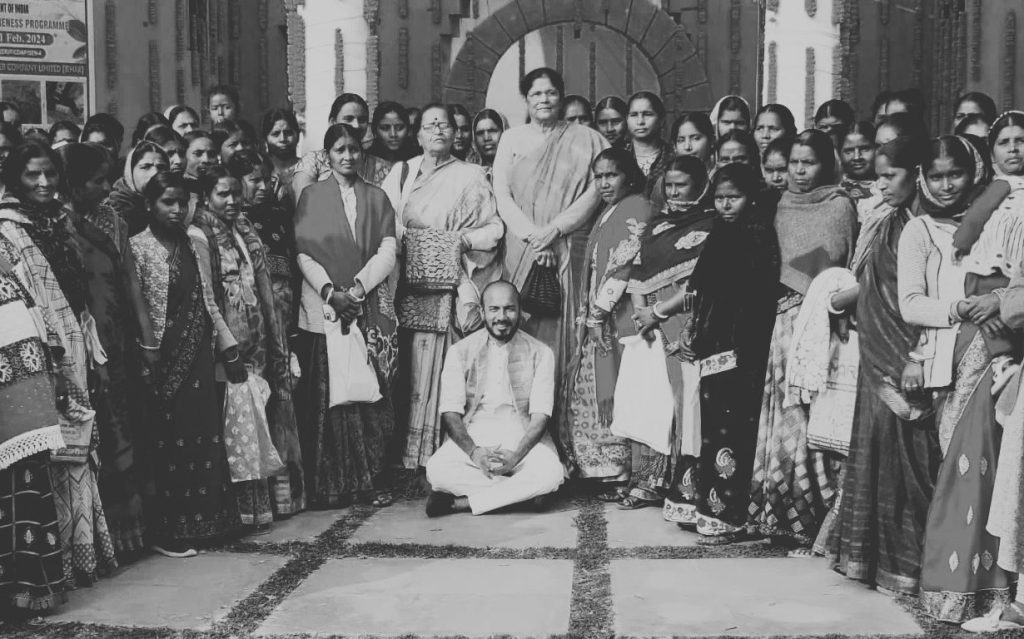
Through my work with leather craft and through community-based initiatives involving hand knitting and crochet in Bihar, I have become increasingly interested in how these skills can connect with contemporary markets.
The challenge is not simply to find craftspeople and ask them to make something.
A business needs to understand the capabilities of the people it works with, develop designs suited to their skills, provide clear instructions, maintain consistent quality, plan production realistically, and create enough demand to sustain the work.
The relationship has to work for both sides.
A brand cannot talk about preserving craftsmanship while treating the craftspeople behind it as an invisible part of the supply chain. Nor can it promise opportunities without understanding whether the business can generate enough reliable work to support them.
This is a responsibility I continue to think about as I build Studio Ek Inch.
I do not believe craftsmanship should be used merely as a marketing story. If we celebrate the hands that make our products, we should also think seriously about the working conditions, skills, income opportunities, and long-term prospects of the people behind them.
Good intentions are important, but they are not enough. They have to translate into practical decisions.
Sustainability is more complicated than a label
The same principle applies to sustainability.
There is growing interest in products made from natural materials, recycled or reclaimed resources, and more responsible production methods. I believe these are important conversations, and they influence the materials and products I explore for Studio Ek Inch.
For example, reclaimed leather offers an opportunity to make use of leather recovered from existing production streams rather than relying exclusively on newly sourced material. Cotton canvas can offer durability and versatility when used thoughtfully.
But I have learned to be cautious about treating any single material as a complete sustainability solution.
The environmental impact of a product depends on many factors: where its materials come from, how they are processed, how much waste is generated, how long the product lasts, how it is transported, and what happens when it is no longer usable.
A material choice may offer certain advantages while introducing other challenges. A handmade product may require more time or resources than expected. Small production quantities may make sourcing and manufacturing less efficient.
These questions deserve honest answers.
I would rather continue learning and improving than make claims that sound impressive but cannot be properly supported.
For a small brand, sustainability is not a destination that can be reached simply by selecting a particular material. It is an ongoing process of making better decisions within the realities of production, cost, and available resources.
What happens after the product is made?
There is another challenge that people outside the business may not fully appreciate: making a good product does not guarantee that people will discover it.
A small brand can invest months in product development and still struggle to attract customers.
You have to photograph your products, build a website, explain their features, create content, manage social media, understand search engines, reach potential customers, and find ways to earn their trust.
You are not only designing and manufacturing. You are also learning marketing, e-commerce, finance, operations, and customer service.
At Studio Ek Inch, I have had to learn many of these things along the way. Building a brand has pushed me far beyond the boundaries of design.
Sometimes the challenge is not that a product lacks quality or thought. The challenge is simply that the right audience has not discovered it yet.
For an independent brand, visibility is not a superficial concern. It can determine whether the next production run is possible, whether a new design can be developed, and whether there is enough demand to continue working with the people involved.
This is why I believe the conversation about Indian craftsmanship must include distribution, marketing, and business development, not just design and production.
Craft needs an audience. It also needs a viable route to that audience.
The financial pressure nobody puts in the campaign photographs
The most difficult parts of building a brand are rarely visible in its finished photographs.
A campaign may show a carefully styled shirt, a beautifully constructed bag, or a product placed in an inspiring setting. It does not show the uncertainty of managing cash flow, the pressure of meeting production commitments, or the anxiety of deciding where limited resources should go.
As a founder, you often have to make decisions without knowing whether they will work.
Should you invest in developing a new product or focus on selling existing inventory? Should you spend money on marketing when cash is already tight? Should you accept an order that stretches your production capacity? How do you maintain quality when time and money are limited?
These are not abstract business questions. They have real consequences for the people, suppliers, and customers connected to the business.
I have faced financial constraints and difficulties accessing the resources needed to grow Studio Ek Inch. There have been moments when the gap between what I wanted to build and what I could afford to do felt overwhelming.
I am sharing this not because struggle should be romanticised, but because entrepreneurship is often presented as a story of courage, creativity, and eventual success while the uncertainty in between receives much less attention.
Not every difficult period produces an immediate breakthrough. Sometimes you simply have to reassess, make adjustments, and continue with what you have.
Passion can help you endure uncertainty, but it cannot replace working capital, sound planning, or a business model that generates enough revenue to survive.
If we want more independent Indian brands to work with traditional craftsmanship, we need to discuss the practical conditions that allow them to do so.
We need to move beyond celebrating handmade
I believe India has the potential to build contemporary fashion brands that draw deeply from its craft traditions without being confined by them.
Our heritage can inform new silhouettes, new products, new uses of materials, and new ways of thinking about design. Traditional techniques do not have to remain frozen in the past to retain their value.
But making this future possible requires a broader ecosystem.
Designers need access to skilled manufacturing partners. Craftspeople need meaningful opportunities to apply and develop their skills. Small brands need access to finance, reliable suppliers, appropriate production facilities, and customers who understand their products.
Retailers and publications can help by telling more nuanced stories about how products are made and what makes them valuable. Consumers can help by looking beyond the initial price and considering quality, utility, durability, and the people involved in production.
And founders like me have a responsibility to build businesses that can support their own ambitions rather than relying indefinitely on the goodwill of others.
None of this is easy. There are trade-offs, limitations, and questions that do not have universal answers.
But I believe these are the conversations we need to have if craftsmanship is to become more than a theme in fashion campaigns.
Why I continue
I sometimes think about the distance between the person who moved from Bihar to Kolkata in 2014 and the person trying to build Studio Ek Inch today.
I have learned much more about fashion and manufacturing than I knew when I began. I have also learned how much I still do not know.
I have seen the creative satisfaction of bringing a product to life, and I have experienced the frustration of watching a carefully planned process become complicated. I have learned that a business requires patience, but also that patience alone cannot solve every problem.
There are still many things I want to improve. I want to develop better products, strengthen our processes, build a sustainable business, and create opportunities for craftsmanship to find a place in contemporary life.
I cannot claim that I have figured everything out. Studio Ek Inch is still a work in progress, just as I am.
But I continue because I believe there is value in trying to build something that connects design with the skills, materials, and creative traditions around us.
I also believe that the success of such a business should not be measured only by how beautifully its products are presented or how many people admire its story. It should also be measured by whether the business can survive, whether its products deliver on their promises, and whether the people involved can build a better future through their work.
Perhaps that is the real challenge of building a craft-led fashion brand in India.
It is not enough to celebrate handmade. We have to build the conditions in which handmade can thrive.
Because behind every handmade product is not just a craft, but a person whose skill, time, and future deserve to matter.
And if we want these traditions to remain alive, we must make sure that the people who carry them forward have a viable place in the future we are trying to create.
Written By Abhishek Sharma : the founder of Studio Ek Inch, a contemporary Indian fashion and lifestyle brand exploring the intersection of Indian craftsmanship, modern menswear, handcrafted bags, and everyday design.


Leave a Reply